
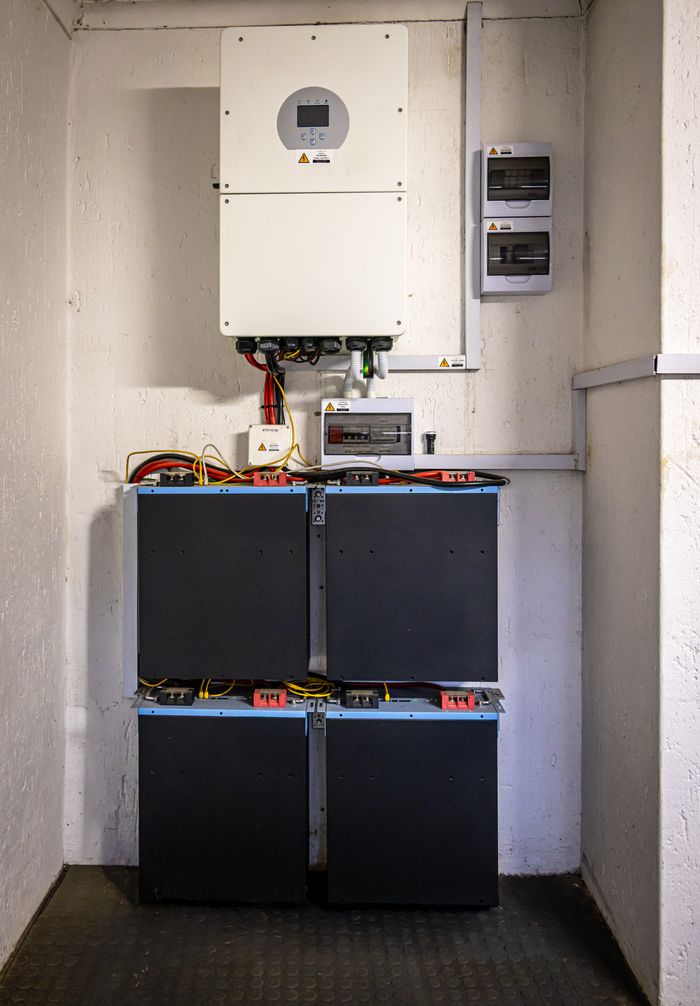
One of the most common questions people ask when planning a solar system is: How many batteries do I need to power my home?
The answer depends on more than the number of appliances you have.
Your battery requirement depends mainly on:
- How much energy you use
- How long you want backup power to last
- Which appliances you want to run from the battery
- Battery capacity
- Battery usable capacity
- Inverter capacity
- Your solar panel capacity
- The battery manufacturer’s specifications
A properly sized battery can provide reliable backup without unnecessarily increasing the cost of your solar system.
Battery Capacity vs Number of Batteries
Before deciding how many batteries you need, it is important to understand battery capacity.
Solar batteries are commonly specified in kWh (kilowatt-hours).
For example:
- 5kWh battery = approximately 5kWh of nominal energy storage
- 10kWh battery = approximately 10kWh
- 15kWh battery = approximately 15kWh
- 20kWh battery = approximately 20kWh
Therefore, two 5kWh batteries provide approximately the same nominal storage capacity as one 10kWh battery.
However, battery capacity is not the only consideration. The battery’s recommended depth of discharge, maximum charge/discharge current, inverter compatibility and installation requirements also matter.
Step 1: Determine How Much Energy You Need
The first step is to estimate how much energy your home uses during the period you want the battery to cover.
For example, suppose your essential loads consume approximately:
- Lights: 300W
- Television: 150W
- Refrigerator: 200W average
- Fans: 200W
- Wi-Fi/router: 30W
- Other small loads: 120W
The combined average load would be approximately 1,000W, or 1kW.
If these loads operate for an average of 5 hours from the battery:
1kW × 5 hours = 5kWh
You would therefore need roughly 5kWh of usable battery energy for those loads over that period.
This is only an example. Actual household consumption varies significantly.
Step 2: Decide How Long You Want Backup
Your required battery capacity depends heavily on your desired backup time.
For example, if your essential loads use approximately 2kWh per hour:
| Backup time | Approximate energy required |
|---|---|
| 2 hours | 4kWh |
| 4 hours | 8kWh |
| 6 hours | 12kWh |
| 8 hours | 16kWh |
These are simplified calculations and do not account for inverter losses, battery limitations or changes in load.
The longer you want the battery to power your appliances, the more storage capacity you generally need.
Step 3: Consider Essential Loads
You do not necessarily need to power every appliance in your house from the battery.
Many solar systems are designed around essential loads.
These may include:
- Lighting
- Television
- Refrigerator
- Fans
- Wi-Fi
- Computers
- Security systems
- Selected sockets
High-power appliances such as air conditioners, electric cookers, water heaters and pumping equipment may require a much larger battery and inverter if you want to operate them for long periods.
This is why two houses with the same number of bedrooms may require very different solar systems.
Can a 5kWh Battery Power a Home?
A 5kWh battery can provide useful backup power, but how long it lasts depends on the connected load.
For example, if your average load is 500W:
500W × 4 hours = 2kWh
If your average load is 2kW:
2kW × 4 hours = 8kWh
The second situation requires considerably more battery capacity.
So it is not correct to say that a 5kWh battery will always power a house for a particular number of hours.
The actual runtime depends on what you are running.
What About a 10kWh Battery?
A 10kWh battery provides approximately twice the nominal storage of a 5kWh battery.
It can therefore provide significantly longer backup when the connected load remains the same.
For example, if your essential loads average 1kW, a 10kWh battery has approximately 10 hours of nominal energy before accounting for usable-capacity limits and system losses.
If the load increases to 2kW, the theoretical runtime becomes approximately 5 hours.
Actual runtime will vary because household loads are rarely constant.
What About a 15kWh Battery?
A 15kWh battery may be suitable for homes that require longer backup or have higher essential loads.
For example, if your average battery load is approximately 1.5kW:
1.5kW × 8 hours = 12kWh
A battery with 15kWh nominal capacity may provide the required energy, subject to the battery’s usable capacity, inverter efficiency and other system limitations.
This illustrates why battery sizing should start with your energy requirement rather than simply choosing a battery based on its size.
How Many Batteries Do I Need?
Suppose you have 5kWh batteries and your system requires approximately 15kWh of nominal storage.
You could use:
5kWh + 5kWh + 5kWh = 15kWh
If you instead use 10kWh batteries, you would need approximately:
10kWh + 10kWh = 20kWh
The actual number and configuration depend on the battery model, inverter requirements, maximum current, communication compatibility and manufacturer’s installation instructions.
Not every battery can simply be connected to another battery.
Don’t Ignore Battery Discharge Limits
A battery’s nominal capacity does not necessarily mean you should use 100% of it on every cycle.
For example, if a battery has a nominal capacity of 10kWh but the recommended usable portion is lower, the available energy for your loads will also be lower.
The manufacturer’s specifications should be used to determine the appropriate usable capacity.
This is particularly important when comparing different battery brands.
Your Inverter Also Matters
Battery capacity and inverter capacity are two different things.
A 10kWh battery does not mean you automatically need a 10kW inverter.
The battery tells you approximately how much energy can be stored.
The inverter determines how much power can be supplied to the loads at a particular moment, within its specifications.
For example, a home could have:
10kWh battery + 5kVA inverter
or
15kWh battery + 10kVA inverter
depending on the system design and equipment specifications.
The correct combination depends on the loads and the required operating conditions.
Don’t Forget Your Solar Panels
A large battery needs sufficient charging power.
Installing a large battery without enough solar generation can result in slow charging, especially when the grid is unavailable and the system depends primarily on solar energy.
For example, a system with substantial battery storage may require a suitably sized solar array to replenish the energy used during the previous night.
Solar panel capacity should therefore be considered together with:
- Battery capacity
- Daily energy consumption
- Inverter capacity
- Available sunlight
- Charging limits
- Desired backup time
What If I Want to Run an Air Conditioner?
Air conditioners can significantly affect battery sizing.
A system designed to run lights, fans, a refrigerator and television is very different from a system expected to run those loads plus one or more air conditioners throughout the night.
If you want an air conditioner to operate from the battery, you need to consider:
- Air-conditioner power consumption
- Operating hours
- Starting characteristics
- Inverter capacity
- Battery discharge capability
- Solar charging capacity
This is why solar packages should be designed around actual load requirements rather than battery capacity alone.
Should I Buy One Large Battery or Several Smaller Batteries?
Both approaches can be possible.
The decision depends on factors such as:
- Available battery models
- Cost
- Inverter compatibility
- Maximum battery current
- Battery communication
- Installation space
- Future expansion
- Manufacturer requirements
Several batteries may make future expansion easier in some systems, while a larger battery may simplify the installation in others.
The manufacturer’s requirements should always be followed when connecting batteries in parallel or in a battery bank.
How to Calculate Your Battery Requirement
A simple starting point is:
Battery energy required = Average load × Backup time
For example:
If your essential loads average 1.2kW and you want approximately 8 hours of backup:
1.2kW × 8 hours = 9.6kWh
You would then consider inverter losses, battery usable capacity and a suitable operating margin before selecting the actual battery capacity.
This means you would not simply buy a battery rated exactly at 9.6kWh without considering the rest of the system.
Common Battery Sizing Mistakes
1. Choosing a battery based only on inverter size
A 10kVA inverter does not automatically require a particular battery capacity.
Battery sizing depends on energy requirements and the inverter’s operating requirements.
2. Ignoring actual appliance usage
Knowing that a house has three bedrooms does not tell you how much energy it consumes.
Two three-bedroom houses can have completely different energy requirements.
3. Forgetting high-power appliances
Air conditioners, pumps, electric cookers and water heaters can significantly increase energy consumption.
4. Installing a large battery with insufficient solar
A large battery still needs adequate charging power if you want solar energy to replenish it efficiently.
5. Ignoring future loads
If you plan to add another air conditioner, freezer, borehole pump or other major appliance later, it may be worth considering this during the initial system design.
Final Thoughts
There is no single battery size that is suitable for every home.
A small system may only require a few kilowatt-hours of storage, while a larger home with higher loads and longer backup requirements may need 10kWh, 15kWh, 20kWh or significantly more.
The correct approach is to start with your actual energy consumption and desired backup time, then select the battery, inverter and solar panels as a complete system.
If you’re planning a solar installation, Gotech Solar can help you assess your loads and design a system around your actual energy requirements.
Need help choosing the right solar system for your home or business?
Contact Gotech Solar for solar system design, supply, installation and maintenance.
Frequently Asked Questions
How many solar batteries do I need for a 3-bedroom house?
There is no fixed number. The required battery capacity depends on the appliances being powered, their energy consumption and how many hours of backup you require.
Is a 10kWh battery enough for a house?
It can be enough for some homes, particularly when powering essential loads, but it may not provide sufficient backup for a home with high energy consumption or multiple air conditioners.
How long will a 10kWh battery last?
It depends on the load. A 1kW average load would theoretically use 10kWh in 10 hours, while a 2kW average load would use the same amount in about 5 hours. Actual runtime will be affected by usable battery capacity, inverter losses and changing loads.
Can I add more batteries later?
Some battery and inverter systems support expansion, but this depends on the specific equipment and manufacturer’s requirements. Expansion should be planned carefully to ensure compatibility.
Do I need more batteries if I have more solar panels?
Not necessarily. Solar panels generate energy, while batteries store energy. Adding panels does not automatically mean you need more batteries. The correct balance depends on your energy consumption, charging requirements and desired backup.
Can a 5kWh battery run an air conditioner?
It may be able to, depending on the air conditioner’s power consumption and the inverter and battery’s discharge capabilities. However, how long it can run the air conditioner depends on the actual load and available battery energy.
Is a bigger battery always better?
Not necessarily. A larger battery provides more storage, but it also costs more and requires adequate charging capacity and compatible equipment. The goal is to choose a battery capacity appropriate for your actual energy needs.